NLT
		   logo and link to NLT home pageTalk To Your Baby logo and link
Developing language for life

Baby signing and language development

The baby signing debate Also see

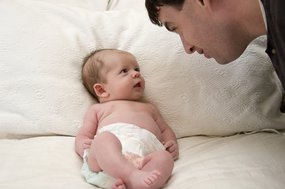
Mother and baby. Photo: Sure Start

The baby signing debate: the supporter's view

Signing the way?

Classes for signing seem to be springing up everywhere. So are they just a fad for pushy parents, or do they sign the way to enhanced parent-children relationships? Should they be part of Surestart provision? Having developed her department's Accelerating Babies' Communication Programme, Tania Allen is clear about the route we should take.

As a speech and language therapist with a particular interest in using positive interaction techniques to develop delayed language, I was fascinated when one of the parents attending a parent programme I was running handed me 'Joseph Garcia's SIGN with your BABY Complete Kit' that she had been sent by her brother in America. The pack advocated the introduction of Amercian Sign Language to normally developing, hearing babies as young as 8 months. The idea of introducing signing to babies in the absence of any difficulties or risk of delay was new to me. We have all seen how the introduction of signs has a positive impact on our language delayed population, but what would be the point of signing with pre-verbal infants who were likely to begin to speak within the next 12 to 18 months anyway?

On watching the video the evidence to support such a move was compelling and I was hooked. Onto the screen came baby after baby signing 'more', 'milk', 'hurt' and much more. Here were babies showing that they had thoughts and needs that would previously have gone unexpressed, as their spoken language was simply not yet developed enough. Children able to express themselves at a much earlier age than would be possible with their spoken language meant that parents reported reduced levels of frustration. In addition an intimate bond could be seen between parent and infant as the signs were taught and understood.

Intrigued, I set about finding out more and discovered the original research into the use of baby signing took place in America in the late 1980s. Almost simultaneously research was taking place in two camps, Joseph Garcia in one and Linda Acredolo and Susan Goodwyn in the other. Having worked as an interpreter, Joseph Garcia had a wide network of friends in the deaf community and he had noted how the hearing offspring of signing deaf parents began to use signing long before their spoken language developed. In 1987, Garcia began to research the use of Amercian Sign Language with hearing babies who are exposed to signs regularly and consistently at six to seven months of age can begin expressive communication by their eighth or ninth month.

Drs. Linda acredolo and Susan Goodwyn conducted a longitudinal study funded by the National Institutes of Child Health and Human Development. The study showed that signing babies understood more words, had larger vocabularies and engaged in more sophisticated play than non-signing babies. Parents of the signing babies in the study noted decreased frustration, increased communication, and enriched parent-infant bonding. Signing babies also displayed an increased interest in books (Moore et al, 2001).

They revisited the families in the original study when the children were seven and eight years old. The children who signed as babies had a mean IQ of 114 compared to the non-signing control group's mean of 102 (Acredolo and Goodwyn, 2000).

Garcia, Acredolo and Goodwyn then set about pioneering the use of signing with babies. Joseph Garcia developed the SIGNwith your BABY program and and Linda Acredolo and Susan Goodwyn produced a book called Baby Signs.

The overall message in both is similar, although there is on main difference: Joseph Garcia promotes the use of a standard sign language such as American Sign Language or British Sign Language, whereas Acredolo and Goodwyn advocate parents and infants making uptheir own signs.

Baby signing classes for hearing babies were then introduced in the United States and, due to the success of the programes in America, baby signing is becoming increasingly popular in the United Kingdom, with advocates for signing appearing on daytime television, news shows and in the press.

Following further research into the field, I contacted Joseph Garcia's team and registered as a SIGN with your BABY presenter. I initially began running baby signing courses as an independent venture. It seemed to make prefect sense. Teaching signs such as waving 'bye bye' and hand rhymes such as 'Insi Winsey Spider' is readily acceptable, so why not build up the ability to use hand gestures that appear at a developmentally earlier age than speech?

However, as a consequence of the recent press and television coverage, local interest in baby signing was developing. Surestart workers, parents and health visitors were asking if our speech and language therapy service ran baby signing courses. The time seemed ripe to develop a preventative programme that capitalised on parents' interest in something new but also 'snuck in' the positive adult-child interaction techniques to a captive audience that would otherwise have been hard to reach. Subsequently I developed the Accelerating Babies' Communication programme to address the demand.

Positive interaction strategies
The programme runs weekly over four 1 hour sessions and involves showing parents of pre-verbal infants how to introduce British Sign Language, based on Joseph Garcia's SIGNwith your BABY approach, and demonstrating positive interaction strategies from the TIME to TALK preverbal communication programme, a parent course that colleagues and I had run successfully for many years with parents of children with delayed/disordered language development.

The infants participating in the programme can be as young as 6 months as parents learn the techniques and then introduce the signs at around 8 months. The course objectives are that carers will:

  • develop a special bond with their infants through excellent communication
  • be appraised of the delights and benefits of signing with babies
  • have an initial signing vocabulary of over 30 signs
  • understand when and how to introduce new signs
  • be aware of how communication develops and the influences on this
  • be aware of positive interaction strategies that promote spoken language development.

Care was taken in the development of the programme to address different learning styles and present activities in a fun, interactive way. The course is also designed to be jargon-free with a commonsensical approach, so that it could be run by professionals other than speech and language therapists, such as nursery teachers or health visitors.

The benefits of signing that I have observed whilst running three Accelerating Babies' Communication programmes are:

1. Signing allows an infant to communicate accurately their thoughts, needs and feelings before they can speak.
2. Signing reduces frustration for babies. The second year of life can be one of great frustration for infants and their carers. One of the major causes of tantrums is the toddler's inability to communicate.
3. Signing gives a window into the infant's mind and personality, as they can communicate outside of the here and now.
4. Signing enhances parent-child bonding, facilitating a close relatinship between parent and child.
5. Signing promotes excellent interaction. Why? Because when using signing, parents automatically adopt positive interaction strategies such as following the child's focus of interest, making eye contact, speaking slowly, and using simple key words (Goodwyn et al, 2000)
6. Signing facilitates an adult's ability to interpret early attempts at words and to assign meaning to them (e.g. Thomas says 'ba' and signs bath, and says 'ba' and signs ball. Because he is using signs as well, his dad knows exactly what he wants.
7. Signing children tend to be more interested in books. Using signing alongisde looking at books allows an infant to become an active participant in the story telling and their interest in books soars.

A new client group
I'm constantly amazed by at the demand for baby signing in our SureStarts. In Canterbury we had been running a drop-in Language and Play group for preverbal toddlers and attendance was extremely poor - more a case of drag-in than drop-in. However as soon as we advertised the baby signing course we had 25 mums keen to come. We now use the Language and Play group as a follow-on group to keep parents' interest in communication high. My next goal is to have a couple of the mums who have used baby signing take over the running of the ABC course.

Tania Allen is head of paediatric speech and language therapy with East Kent Coastal Teaching Primary Care Trust, Royal Sea Bathing Hospital, Canterbury Road, Westbrook, Thanet CT55BQ.

An extract from Signing the way?, Tania Allen, Speech & Language Therapy in Practice, Winter 2004.


Formal signing systems

The advantages of using a formal system rather than making up your own signs are that:

  • Everyone who is in contact with your child can use the same signs, making it easier to learn the sign and its meaning.
  • Any signs used by your child can be understood by those who know that sign system.
  • People are less likely to get confused about the meaning of any given sign.

Commonly used signing systems include:

  • British Sign Language (BSL), unlike other signing systems, is a fully fledged language, used by deaf people in the UK. For more information go to www.britishsignlanguage.com
  • Makaton and Signalong are the systems most commonly used by speech and language therapy departments for children with a wide range of difficulties. They use some signs taken from British Sign Language. Signs are used at the same time as spoken language, providing additional clues to help children understand what is being said. For more information go to www.makaton.org or to www.signalong.org.uk
  • Paget Gorman - a signing system that was developed specifically to support children with primary speech and language difficulties. Paget Gorman is used in some special schools and units for children with specific speech and language impairments. Like Makaton and Signalong, Paget Gorman follows the word order of spoken English. For more information go to www.pgss.org

Speech and language therapy departments often offer classes in the signing systems they use. Alternatively, you can contact the organisations that represent the different options directly for information about classes you could attend, videos, CD-ROMs and other information materials that are available.

(Extracted from 'Information for parents: Speech and language difficulties', published by Early Support, 2005)


Baby signing: the view from the sceptics

Arguing against signing with babies is a bit like arguing against motherhood and apple pie, since signing and gesture are (like talking) natural ways of communicating used all over the world. We aren't saying it's a bad thing, but we are saying that professionals should ask themselves some basic questions before leaping on this extraordinarily fashionable bandwagon.

We suggest asking:

  • what roles do sign and gesture play in early development?
  • is it necessary to sign to babies?
  • who benefits?

We know that babies develop signed or spoken language in situations where carers are offering sensitive contingent responses and appropriate stimulation for requests, naming, communication of feelings and social behaviours. The argument for the introduction of sign to babies rests on research suggesting that babies learning sign as a first language produce their first signs slighly earlier than babies produce their first spoken words.

Several explanations have been put forward for this reported sign advantage. One suggestion is the differing maturation rates of the motor system for hand movements when compared with that of the speech apparatus. However, these early signs actually seem formationally identical to the gestures produced by both deaf and hearing babies - hand opening and closing for more or milk for example. So the 'signs' are acutally gestures that all babies produce (see discussion by Volterra et al, in press).

Acredolo and Goodwyn (2004) state: "Research has shown that signs are easiest for babies and for parents when they involve simple gestures and when they ressemble the things they stand for, e.g. fingers to lips for 'eat'; arms out straight like wings for 'airplane.'" If you reinforce particular gestures and particular sounds, babies will develop their communication skills in several different modalities. There does appear to be a short period during which infants can produce more differentiated and controlled hand gestures than speech sounds, but it is a transitory phase. By the time children have started to produce their first words and then combine them, the timelines for signs and words appear to be essentially similar.

However, if we paid as much attention to babies' vocalisations as we do to their hands, we would find that gestures are likely to be accompanied by protowords - consistent vocalisations that are word-like. Amazing. If we actually attend to what our babies are vocalising, imitate their sounds back to them and present them with contexts where their sound making has meaning, perhaps they will talk as well as sign.

For example, my granddaughter at eight and a half months was saying 'tat' for cat and other things that interested her, and at 10 months has a range of six or seven vocalisations associated with particular events and feelings. We think we might start marketing this novel approach. We could call it Baby Talk. We would be very hapy to provide workshops, videos and CD-ROMs (at a price).

Is it necessary?
Garcia (1999) and Acredolo and Goodwyn (2002) claim that children can learn signs before they can learn words, and that teaching them signs will lead to measurable differences in behaviour and cognition. "Research in the USA reports that, by being taught signs, hearing babies can understand and express language long before they are physically able to speak. Parents who have used Garcia's methods for signing with hearing babies as young as seven or eight months claim that it can help communication, verbal language development and dramatically reduce frustration - even a few simple signs like 'more', 'eat, and 'milk' can make a big difference in empowering and meeting the needs of babes" (from the Northlight Communications catalogue).

The argument is that babies are experiencing huge frustration because they cannot communicate. To our knowledge, there is no research which suggests that this is the case for typical babies, who are generally pretty good at making their needs known. Using some symbolic gestures is part of normal parenting, but we are not at all clear that anyone needs to go on a course, buy videos or do anything other than use the range of skills they naturally possess. Speech and language therapists, in particular, should be seeking to empower parents to use gestures (a huge range applicable, such as come, eat, bye-bye, drink, go, look at that, clap, cuddle, no, phone) and the equivalent sounds or 'vocal gestures' (mm, lip smack, animal noises, bang, ooh, wow) that children will easily pick up at this age to show their feelings and interests.

We know of at least one case (from a colleague at City university) where a mother's decision to focus entirely on teaching baby sign and to ignore vocalisations has actually retarded her son's spoken language development. So we suggest that therapists should encourage parents to develop all means of communication, and not just one at the expense of another.

In fact, the most hepful thing parents can probably do for their children between the ages of eight and 12 months is to encourage them to point, since there is very sound research suggesting that the use of pointing is associated with joint attention and the development of object naming and language development.

Statements such as, "Do you want to strengthen the bond with your baby by being able to communicate with them before they can speak? By attending a Signing Infants Workshop, you too can start on the amazing journey of communicating with your baby," (from a British website) are particualrly disingenuous, suggesting that parents cannot communicate with their babies until they sign.

Manual gesture is, of course, extremely useful for babies whose development is compromised, including children with special needs, children with hearing loss and children who are not developing spoken language. In this context, baby sign does have the useful function of making signing a more acceptable avenue of development, and this is certainly welcomed. But this brings us to our next question.

Who benefits?
It is quite staggering to see the rash of websites, books, videos, workshops and training courses. All are promoting 'baby sign' and using signs form the language of deaf people. Well, it's certainly making a lot of money for someone. But are deaf people benefiting? Do we see any evidence of any of the profits being donated to organisations that support deaf children and their families? More pertinently, even, who do you think are the real experts in using baby sign? Is it the hearing promoters who have copyrighted the name, or could it just be deaf parents who use their own language with their babies? How nice it would be to see the proponents of baby sign inviting deaf people to be the trainers, the authors and the models in the videos.

So, finally, our suggestions to therapists who would like to advocate the use of signs with parents are:

  • parents don't have to spend loads of money attending workshops and buying vidoes - they can use the gestures they already know;
  • make sure you encourage parents to focus just as much on what babies are saying; and
  • if you do want to give them a wider range of gestures, why not get deaf parents to come and teach them? And pay them the money you would paid the baby signers.

Nicola Grove, Ros Herman, Gary Morgan and Bencie Woll - Speech and Language Therapists, Department of Language and Communication Sciences, City University, London.

(RCSLT Bulletin, November 2004)


View from the Royal College of Speech and Language Therapists

Speech and Language Therapists say baby signing programmes are not necessary for most children

Do parents need to buy baby signing 'programmes' to teach their child to talk - as advocated in recent publicity concerning commercially available baby signing programmes? Not according to the Royal College of Speech and Language Therapists (RCSLT). An RCSLT spokesperson says: "Research evidence supports the use of gestures to help babies focus on what they hear - much as child-directed speech does - as part of 'normal' parent-child interaction. There is also some evidence that supports signing for babies with Down Syndrome to help speech and language development. "However, it is not necessary for parents to learn formal signing such as British Sign Language for children with no identified risk of speech and language development. A structured signing 'programme' is not necessary to enhance the communication development of typically developing children. "The College is concerned that the use of signing does not replace/take priority over the need for parents to talk to their children."

(Royal College of Speech and Language Therapists, Press Release, 27 October 2003)


Baby talk

Every parent can find it frustrating when their baby cries and they can't quite work out why. Of course, a little parental instinct, common sense and a lot of luck has gone a long way for countless years, but now eager mums, dads and carers are queuing in their thousands for classes in the newly popular means of communication: baby signing.

The technique, originally explored by American child development researcher Joseph Garcia, enables hearing children as young as six months to use simple symbols and gestures to communicate their basic needs and emotions with their parents. If your baby wants his teddy, needs to go to bed or simply feels like telling you he's seen a bird in the sky, there are simple signs with which he can now communicate it to you.

Whether you think it's a fad, a bit of fun or an essential development tool, it looks like baby signing is here to stay, with classes springing up all over the UK and even dictionaries of key signs on sale. Advocates of the system sing signing's benefits, claiming it reduces babies' frustration, strengthens the bond between child and parent and encourages a child to speak earlier than usual. Some even claim that signing leads to a higher than average literacy level and a wider vocabulary.

Musician Sasha Felix created Sing and Sign (www.singandsign.com) after teaching her own daughter basic signing symbols and music with great success. She consulted speech and language therapists and soon her Brighton-based classes were a runaway success. Now new Sing and Sign groups have started up all over the country. Sasha believes that baby signing encourages the development of your baby's speech, and bridges the gap between your baby's first understanding of the meaning of words and gestures, and actual speech.

"The big thing that we push is that it's natural and it's a typical part of speech and language development anyway," she said. "The whole point is that babies already use gestures, and we just expand the range of gestures that they use. They already wave goodbye and raise their arms when they want to be picked up.

"The amazing thing has been how easily the babies have picked the signs up. They are even able to remind their parents of things that happened yesterday."

Liz Attenborough is the manager of the Talk to Your Baby campaign for the National Literacy Trust, an independent charity dedicated to building a literate nation. The Talk to Your Baby campaign aims to encourage parents to talk to their children from birth, to help them become good commicators and enjoy happier and more successful lives.

On baby signing, Liz commented: "In small doses, this seems like another example of good communication. We are looking for any form of communication between babies and their carers and if this improves the process then it's a positive thing."

But, of course, not everyone thinks baby signing is necessary. The Royal College of Speech and Language Therapists (RCSLT) is concerned that some parents will worry unnecessarily that they are unable to take their child along to classes.

"A structured signing 'programme' is not necessary to enhance the communication development of typically developing children," a spokesman said. "The College is concerned that the use of signing does not replace/take priority over the need for parents to talk to their children."

However, baby signing, this relatively new phenomenon, appears to be having a positive effect on the relationship between carer and child, encouraging them to spend that all-important time together. Your baby may not be able to speak, but he can certainly communicate. It's not something which is essential for all, but, if you are interested in sharing more with your child, understanding his needs and perhaps giving him a head start on speech, then it may be worth seeing if baby signing is for you.

Emma Scott, mother of 17-month-old Tabitha, who joined the classes earlier this year, agrees that signing has had a positive effect on her daughter's development.

"So many friends have said this was a frustrating time for them, but we have a very calm baby," she said. "We're quite passionate about it because it's been so wonderfully rewarding to have our daughter communicate back to us."

Taken from babyzeen.co.uk; written by Jennifer Bradly, September 2004


Look who's talking, written by Lucy Atkins for the Guardian, 27.07.05

Should you be teaching your baby sign language? Or is the latest child education craze a total waste of time? Lucy Atkins, mother to a non-verbal yet very communicative 14 month old, investigates

Yesterday, 15-month-old Charlie Parrott anxiously approached his Mum, Sam, as she was drying her hair. "Where's Daddy?" he asked. "Daddy's downstairs in the shower," she replied. "Great!" said Charlie, who picked up his teddy and bottle, and toddled downstairs to find Daddy.

Charlie is not some linguistic genius. This exchange took place entirely in sign language. Neither Charlie nor Sam is deaf, but together they've been going to baby-signing classes since Charlie was eight-months old. If you watched the movie Meet the Fockers you may have some notion of what baby signing is about. Robert De Niro's character is the uber (grand) parent of our time: he straps on fake breasts to prevent his one-year-old grandson from developing "nipple confusion", allows him to play only with pre-approved toys, and communicates with him using sign language. Despite the intended satire, the movie had a big effect on US parents: sales of Joseph Garcia's Sign With Your Baby kits rocketed. And the phenomenon has now made its way over here: in September, Garcia, the world's foremost proponent of baby signing, will publish his first UK instruction manual - Joseph Garcia's Complete Guide to Baby Signing.

The idea makes sense: a baby's motor skills develop way before their verbal ones, so babies as young as seven months can produce hand signals to communicate - many months before they could do so linguistically. Like most children his age, Charlie's verbal skills amount to eloquent babble interspersed with a handful of "real" words - Mummy, Daddy, hat and duck. But he used his first sign - "milk" - at nine months (thereby simplifying his parents' lives significantly), and at 11 months could ask for food and drink and understand a range of signs for his everyday activities. At 15 months, he habitually use about 15 signs including: more, park, food, teddy, book, bath, swing and where.

"It has taken the uncertainty out of parenting," says Sam. "Instead of constantly wondering, 'What on earth's wrong with you now?', Charlie can tell us." Baby signing is nothing new. Garcia, a teacher who originally worked with hearing children of deaf parents, spotted the commercial potential of baby signing 15 years ago when he noticed that far from having delayed language development, the children he worked with tended to speak earlier than their peers. The idea is that because you always speak the word at the same time as you sign it, signing in fact reinforces a baby's grasp of how language works. Which perhaps explains why Garcia is now so well known in the States that gushing parents stop him at airports to thank him.

Here, meanwhile, parents who sign to their hearing babies "still definitely get a few funny looks," says Emma Finlay-Smith, director of the newly established group Baby Signers, the first to use Garcia's system in the UK. There are currently about 100 baby-signing classes running in the UK under different banners (Sing and Sign, and Tiny Talk, for instance, both combine music and sign language), and some Sure Start schemes have begun to run drop-in "play and language" classes that incorporate baby signing. Indeed, claims Finlay-Smith, "it's fast becoming the normal thing to do with your baby."

"Baby signing certainly seems to be filling some void," says Kamini Gadhok, director of the Royal College of Speech and Language Therapists (RCSLT). There is currently a debate raging about it in the RCSLT journal. Some therapists are wildly enthusiastic - others less so. As one group of academics wrote: "If we paid as much attention to babies' vocalisations as we do to their hands, we could find that gestures are likely to be accompanied by protowords - consistent vocalisations that are word-like..We think we might start marketing this novel approach. We could call it Baby Talk. We would be very happy to provide workshops, videos and CD-roms (at a price)."

Are they right to be so sceptical? The window during which your baby can make gestures but not talk is pretty small. A baby's vocal cords typically develop the capacity for speech at around 18 months, so even if you start early and your baby makes his first sign at around eight months, you're talking less than a year where it's your main form of communication. You will, of course, gain an extremely valuable capacity to communicate with deaf people - not to be sniffed at - but beyond that, is this all just another guilt trip for harassed parents?

I have three small children and my youngest, who is 14 months old, seems to be getting his feelings across to the rest of us pretty effectively. He may not know British Sign Language (BSL) but like most of his peers he can say a few key words including "No!". He can also point, grab, pull, yell, make animal noises, creative gestures and, if all else fails, will physically manipulate us around the house to achieve his ends. I may be too busy to take him to baby Sudoku classes (it's an achievement, sometimes, just keeping them all alive) but I certainly do not feel, as the Baby Signing book suggests, that he is sitting mutely, a "passive observer waiting in the wings to emerge once he has learned how to speak." Indeed, right now it frequently seems that we're all mere pawns in his plans for world domination. Were I a paranoid first-time parent, however, this sort of guilt trip might genuinely get to me.

As might the notion that I'm "missing out" on the fascinating internal world he's dying to share with me. Signing, says Garcia "is a vehicle that allows babies to tell their parents what is going on for them." "When Isabella was 12 months old we were in Marks & Spencer," says Finlay-Smith. "She signed 'rabbit'. We thought she'd gone mad. But the rabbit in question turned out to be a man with very buck teeth. It blew me away how much was going on in her head: the connections she'd made."

This is certainly an intriguing notion. Most parents of pre-verbal children at some point think, what's going on in there? But is it worth learning BSL to discover that your baby thinks the man at the checkout needs orthodontic treatment? I'm not convinced. Baby signing will, of course, be tempting to the Baby Einstein buying market. According to baby signing fans, studies show that a signing child will typically be 12 points higher on the IQ scale, at seven and eight years old, than a non-signing child. "Signing intellectually stimulates a baby's brain," says Garcia. It also "changes their psyche about solving problems," he says, making them "typically less apprehensive, more confident and outgoing and [they] tend to adopt leadership roles among their peers." This problem-solving claim is currently based more on observation than scientific data. And it is slightly baffling. Non-signing babies are constantly problem solving too: they have to. One friend told me how her 15-month-old recently dug out her favourite flip-flops and presented them to her, as a "sign" that they should go out. It's not, therefore, terribly clear why BSL as a problem-solving method should confer such special powers. Other studies show that the linguistic advantage that signing children initially have disappears by the age of three.

But there's no arguing with the sales figures: Garcia's book has already sold nearly half a million copies in the US. And even for a knee-jerk sceptic like me there does appear to be one genuinely persuasive argument for learning a few basic signs with your baby. "It will take you an instant to figure out what he wants rather than half an hour," says Garcia. And this significantly reduces tantrums. Having survived two toddlers, I am consciously dreading round three of the terrible twos. One study of toddlers, Garcia tells me, found that non-signers spent on average 20 hours a month having tantrums. Signers, meanwhile, spent only 10 hours a month rigid and screaming on the floor. Forget IQs and social domination, if this isn't a fantastic reason to sign with your baby, nothing is.

"The last thing parents should feel is guilt if they don't have the video or do the classes," says Liz Attenborough, manager of Talk To Your Baby, part of the National Literacy Trust. "There are countless ways to communicate with your baby but a few gestures are certainly useful in early communication, alongside talking and allowing the baby to babble. But I'm not sure that families need to take courses to learn a huge signing vocabulary for that to be effective." Just using Garcia's book I have picked up about 10 signs in a couple of days, and this morning my baby (heavily prompted) signed "up" when he wanted to get out of his high chair. Life is looking up. As soon as he learns "here are your slippers and pipe, Mummy" I'll know it's all been worthwhile.

(Guardian, 27.07.05)


Sign language - the basics

What is it? American child development researcher Joseph Garcia suggests that babies can begin learning baby sign language as early as six months when they are introduced to basic symbols such as 'eat', 'drink', 'milk', 'more', and 'no'. Proponents of baby signing say that it can also help to reduce bad behaviour because children are less frustrated.

Does it work? Gail Flaum from Bushey, Herts, has signed with daughters, Millie, two and Jessie, one. She thinks it was invaluable. "Critics say parents should be able to tell what their children want and by a process of elimination they may get there in the end, " she says. "But by then your child is crying, you're both stressed. It's so much better if she can just sign the word 'drink' and you immediately know what she want.s It hasn't been detrimental to Millie's speech. If anything, I'd say she spoke earlier than many non-signing friend's children."

Expert view Kamini Gadhok, chief executive of the Royal College of Speech and Language Therapists, supports the use of natural gestures but not the use of formal signing if there is no identified problem. "We're concerned that the use of formal signing does not take priority over the need for parents to talk to children. Language should be encouraged through a range of everyday activities."

(Sure Start, Issue 3, Summer 2004)


Baby signing - one mother's experience

In 1987, an American scientist, Joseph Garcia, began researching babies' sign language at the Alaska Pacific University. A decade earlier, he had worked as an interpreter with deaf parents, during which he had observed that their babies, who could hear, started communicating earlier than usual. In this research he used American Sign Language to teach hearing babies of hearing parents. This showed that if signed to regularly, babies would communicate earlier, at around eight to nine months old. This led him to develop his own system of sign language, for parents and their pre-speaking babies. A research study, funded by the National Institute of Child Health and Human Development in America, revealed that signers began to speak earlier than usual and were more interested in books than non-signers. When visited seven or eight years later, it was found that their average IQ of 114 compared very favourably with a mean IQ of 102 for the non-signing control group.

June Rozanski signed up for baby signing classes when her second child was six months old (the optimum age to start baby signing) and found it "marvellous to get a glimpse of his baby thoughts, long before he could speak, and I felt that the bond between us grew stronger. Babies generally learn to speak between the ages of 12 and 24 months. What is less well-known is that they can understand the world around them far earlier than they acquire the skills for talking. Speech is just one method of communication. There are several forms of body language, such as facial expression and gesture, which express thoughts and feelings.

"While babies take time to develop the ability to speak, they are busy acquiring the skill of manipulating objects with their hands; they are already gesturing at around seven to eight months old. It is logical to take advantage of this skill in developing a language using gestures and signs, as babies are naturally able to convey their thoughts by this method.

"Better communication results in parents being better equipped to understand and satisfy their babies' needs. This leads to a happier baby or toddler, who is less frustrated and so has fewer tantrums.

"My son's first sign was a chicken, using fists tucked under his chin and elbows flapping up and down. Before long he had acquired a passive vocabulary of more than 50 words. My son would let me know his needs; for instance if he was tired and wanted to go to bed or needed help. Once I arrived home after a shopping trip to find him in a tantrum and screaming at the top of his voice. I asked him and signed, 'What do you want?' In reply, he signed for his favourite toy and the problem was immediately solved. Other more important signs came in useful when he would suddenly cry while we were in the car and flap his hand up and down to his mouth. I soon knew that he was signing for a drink.

"Everyone's experience will differ. It is essential to be patient because not all children sign quickly."

(Nursery World, 28 August 2003)


A childminder's experience

Margaret Heath from Sheffield has been childminding for 15 years, the past five of them in partnership with her husband, Robert. Both have found their knowledge of Makaton Signing invaluable in working with children who have Down's syndrome, delayed speech, and other communication needs. They recently joined Sheffield's 'special needs' childminding network.

Five years ago, a mum of one of the children they were caring for became pregnant and asked if they would look after the baby part-time when she went back to work. Robert was self-employed at that time, working from home, but he was also registered as a childminder so he could help Margaret out. To enable the Heaths to take on the baby, he decided to work part-time so that he could do more childminding. He enjoyed it so much he was soon childminding full-time.

The baby, Jessica, had Down's syndrome. "At six months, a speech therapist suggested using Makaton Signing with her," explains Margaret, "so we did a beginners' course with funding from an Early Years Intervention grant. Shortly afterwards, our childminding development worker found that our local special educational needs department had funding to train new Makaton tutors, and put my name down." Today Margaret runs Makaton courses about once a month for childminders, nurseries, and even parents.

When Jessica was a year old, her dad came to pick her up from the Heaths' house one day. "We were all stood in the hallway and she looked up and made the sign for 'light'. It was such a wonderful moment, we all cried!" says Margaret. "She went on in leaps and bounds. By the time she was two she could use nearly 300 Makaton signs. At three, she could only speak half a dozen words, but because she could communicate all her needs through signs she never showed frustration.

"We realised that, because we were signing with Jessica, the other children were using the signs to communicate with her, too. One boy we were caring for at that time then went on to school, but still came to us every afternoon. On the first day of his second term, he came running in and said: "Margaret, guess what? There's a new boy in my class and he's got Down's syndrome. He can't speak, but he uses Makaton. And nobody could talk to him except me!"

In a typical day, Margaret and Robert use Makaton signs at breakfast, lunch and dinner, whenever they sing songs or tell stories, and in general play. "Even children who can't normally sit still when you read a story, will sit still if you sign it as well. Signing automatically slows your speech down and makes it more precise. The children concentrate on your hands as well as listening, and the slower pace gives them time to repeat the signs themselves," says Margaret.

The Heaths believe signing definitely promotes spoken language and doesn't delay it. "We always use speech at the same time as signing, as the spoken and signed words emphasise one another. Jessica's first words when she learned to talk at three-and-a-half were all words she could sign."

(Make Chatter Matter, NCMA report to mark National Childminding Week, 2005)


Top Tips to start baby signing

  • Begin with simple word signs such as eat, drink and hot when a baby is aged six to nine months
  • Follow the baby's lead and from nine months onwards, observe what interests the child and introduce signs that will mirror this
  • Always say the word when you sign, never sign in silence
  • Speak slowly and clearly but in a natural way
  • Keep it simple, using just one sign per sentence
  • Be consistent in the signs you use but happily accept any signing attempts from the young child
  • Do not get babies to 'perform' signs on demand
  • Be patient and relaxed about baby signing, using lots of praise

(Taken from an article in Nursery World, 28 August 2003, by June Rozanski)


Useful publications

Amazing baby signing, by Katie Mayne of TinyTalk, is a simple-to-use, step-by-step guide on signing, taking parents through the earliest signs for bottle and food right through to more complex signs. Complete with photographs throughout, amazing baby signing is Published by Templar Publishing.

Baby says....
is a series of board books with flaps giving words and actions to help babies to express themselves. Baby Says Hello, Baby Says Bye-Bye, Baby Says Love You and Baby Says Hooray are by Opal Dunn and Angie Sage (Hodder Children's Books).

Dexter's Dictionary
, produced by Talkfirst, is an A5 ring binder containing 172 signs in full colour. Each page displays images of three signs and descriptions of how to produce them. For more information visit www.talkfirst.net

Joseph Garcia's Complete Guide to Baby Signing
has been written with British parents in mind. It provides an introduction to baby signing and is designed as an easy to use resource for busy parents. It is available from www.babysigners.co.uk

Learn to Sign with Olli
introduces parents and carers and their children to sign language to help children communicate before they are able to speak. Each sign is clearly described and accompanied by a photograph and step by step, woven into four stories about the adventures of Olli the monkey and his family. It is available from www.happyhandz.biz


Useful contacts

Baby Signers
Joseph Garcia's book Sign With Your Baby was the inspiration that led to Emma Finlay-Smith founding the Baby Signers organisation. Joseph Garcia has written a textbook for the organisation that is said to be the first major work to be based on British Sign Language (BSL). Baby Signers also offers a structured, BSL-based programme of classes for parents and for Babysigners teachers. For more information, see www.babysigners.co.uk, email info@babysigners.co.uk or call 01273 882203.

Baby Sign

Baby Sign is an online course to teach baby signing based on British Sign Language. For more information visit www.babysign.co.uk

Cued Speech
Cued speech is a simple sound-based system which uses eight hand-shapes in four positions near the mouth together with the lip-patterns of normal speech to make all the sounds of spoken language fully comprehensible to deaf babies, children and adults. For more information visit www.cuedspeech.co.uk/

Makaton

Makaton is a language programme offering a structured, multi-modal approach for the teaching of communication, language and literacy skills. Unlike the baby signing programmes mentioned above, it was devised for children and adults with a variety of communication and learning disabilities. Makaton signs and symbols are used extensively throughout the UK, and have been adapted for use in over 40 countries. For information on training and parent/carer packs for distance learning, see www.makaton.org, or email mvdp@makaton.org

Sign and Bond Consultancy
Sign and Bond workshops are delivered using British Sign Language (BSL) for all the babies, children, parents and professionals who attend. Some signs are modified to make them easier to use and Sign and Bond work closely with the BSL Academy of the British Deaf Association, an accredited awarding body for Sign Language. Supported by the BSL Academy, Sign and Bond is currently developing a BSL For Babies and Children curriculum. For more information visit www.signbond.co.uk

SignedLanguage
A website with articles and information about sign language and communication. Visit www.signedlanguage.co.uk

Signing Babes

The Signing Babes method includes a few signs taken from the British Sign Language. The website has information and basic signs to help parents get started and Signing Babes runs a range of courses for parents and carers, primarily in the Plymouth and Devon areas. For more information visit www.signingbabes.co.uk

Signs for Success

Kathy Robinson, a hearing mother of two deaf daughters, set up the Signs for Success literacy programme to promote sign language as an educational tool for all children. The programme encourages people to learn one sign a day and to use it in different situations, before moving on to the next word. Teachers, classroom assistants, nursery nurses, dinner ladies, secretaries, cooks, caretakers, parents and children are taking part in the programme. For more information see www.signsforsuccess.co.uk or for training enquiries email kathy@signsforsuccess.co.uk

Sing and Sign
Sing and Sign is a music group with a difference. While enjoying songs and musical activities with their children, parents and carers learn to enhance their babies' communication before they are able to speak, by learning a range of simple baby signs. Sing and Sign uses signs from widely-used UK gesture systems, and suggests introducing signs at any stage before your baby's speech is well established for familiar day-to-day needs. The Sing and Sign DVD is for beginners, while More Sing and Sign is a Stage 2 DVD designed for babies who are already signing at home. For information on local classes or to order a video or DVD (including instruction booklet) see www.singandsign.com, email info@singandsign.com or call 01273 550587.

Small Talk
Small Talk is a DVD aimed at parents wanting to use sign language to communicate with their children at an early age. For more information and to order the DVD visit www.whatsign.co.uk

Talkfirst
TalkFirst baby signing classes include a mix of themed signs, rhymes, music and games that are designed to appeal to babies up to 30 months, with many of the activities led by a signing puppet called Dexter. TalkFirst runs franchises in many areas. For more information visit www.talkfirst.net, email info@talkfirst.net or call 01706 872816.

TinyTalk
TinyTalk runs singing and signing classes to help babies communicate with their parents before they can talk. Baby sign language can begin at around 6 to 9 months, with visual clues (signs) to help babies make sense of everyday words, to bridge the gap before vocal language begins. As well as running classes, TinytalkUK has teaching opportunities with full training packages and on-going professional development. For details of classes and teaching opportunities, see www.tinytalk.co.uk, email info@tinytalk.co.uk, or call 0870 2424898.

WOW

WOW is a signing literacy programme for children, which begins with WOW Babies and leads to WOW Kids. The programme includes the WOW Babies board books and the First Signing ABC, as well as the Fingerspelling Alphabet Pack that includes a poster and pink and yellow gloves to encourage children to practice signing. For more information visit www.wowworldwide.co.uk


Donate Online

Bookshop


The National Literacy Trust is an independent charity and relies on voluntary contributions. If you have found our website useful, please consider making a donation. Every penny helps.


Copyright © National Literacy Trust 2007
Unless otherwise specified, all material on this website may be used for non-commercial purposes, on condition that the source is acknowledged. The NLT is not responsible for the content of external websites.
National Literacy Trust is a registered charity, no. 1116260 and a company limited by guarantee, no. 5836486. Registered in England and Wales.
Registered address: 68 South Lambeth Road, London SW8 1RL